The Founding of Emmaus
A sermon in a farmhouse, a Moravian congregation, and the land two families gave for a village.
Emmaus did not begin as a town. It began as a handful of German farming families in the hills south of the Lehigh, and a congregation that met in one of their houses. Two of those families, the Knausses and the Ehrenhardts, gave the land the village was built on.
From the Wetterau to Whitemarsh
In 1723 Ludwig Knauss and his wife, Anna Margaretha Goerlach, left Tittelsheim, in the Wetterau region of Germany, for Pennsylvania. They settled at Whitemarsh, near Philadelphia, where Ludwig owned a hundred acres and served as a deacon of the White Marsh Reformed church from 1728 to 1739.
Both of their sons went north, and in time both of their daughters followed. Johannes Heinrich, a weaver, and his younger brother Sebastian, a wheelwright, both settled in the country that would become Emmaus before 1740.
A sermon in Ehrenhardt’s house
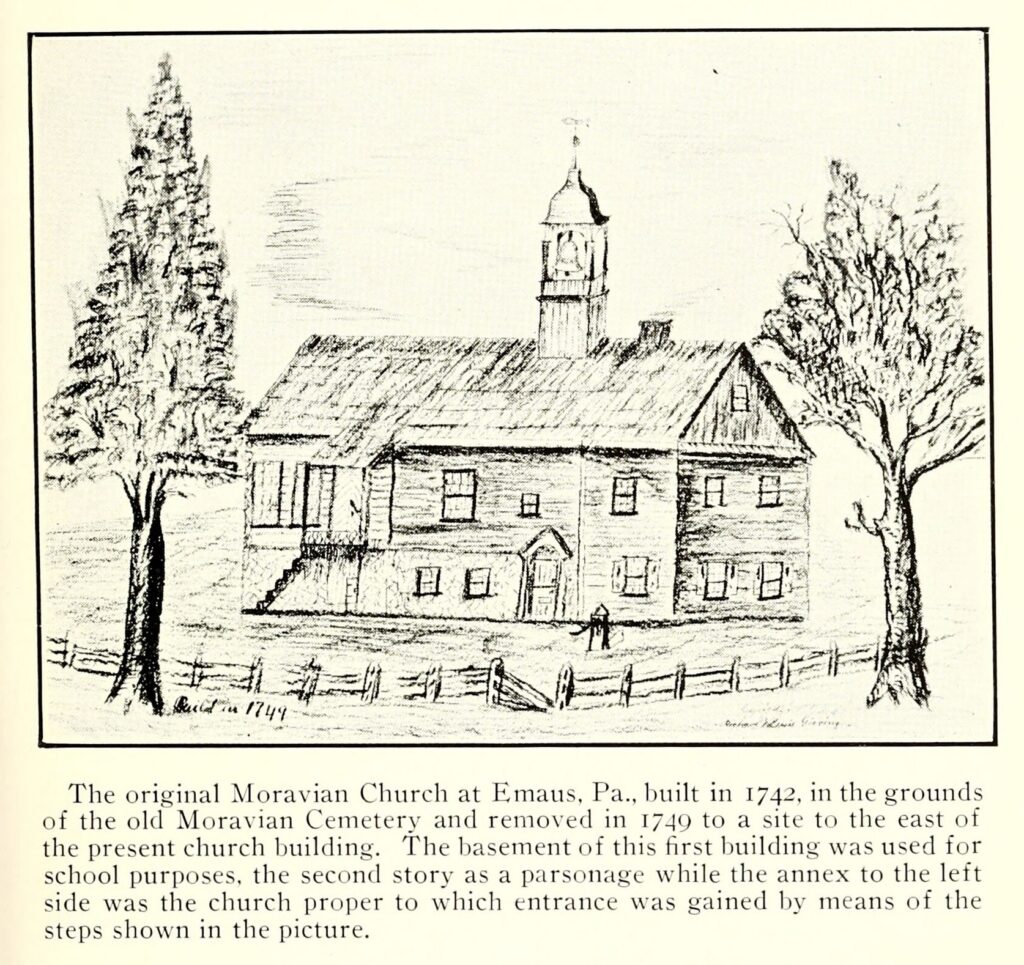
On December 2, 1742, Count Nicholas Ludwig von Zinzendorf, leader of the Moravian Church, preached at the house of Jacob Ehrenhardt. Before the month was out, on December 29, Sebastian Knauss, Ehrenhardt and others were received into the Moravian congregation at Bethlehem. That same year a log church was built in what is now the old burial ground.
A congregation, then a village
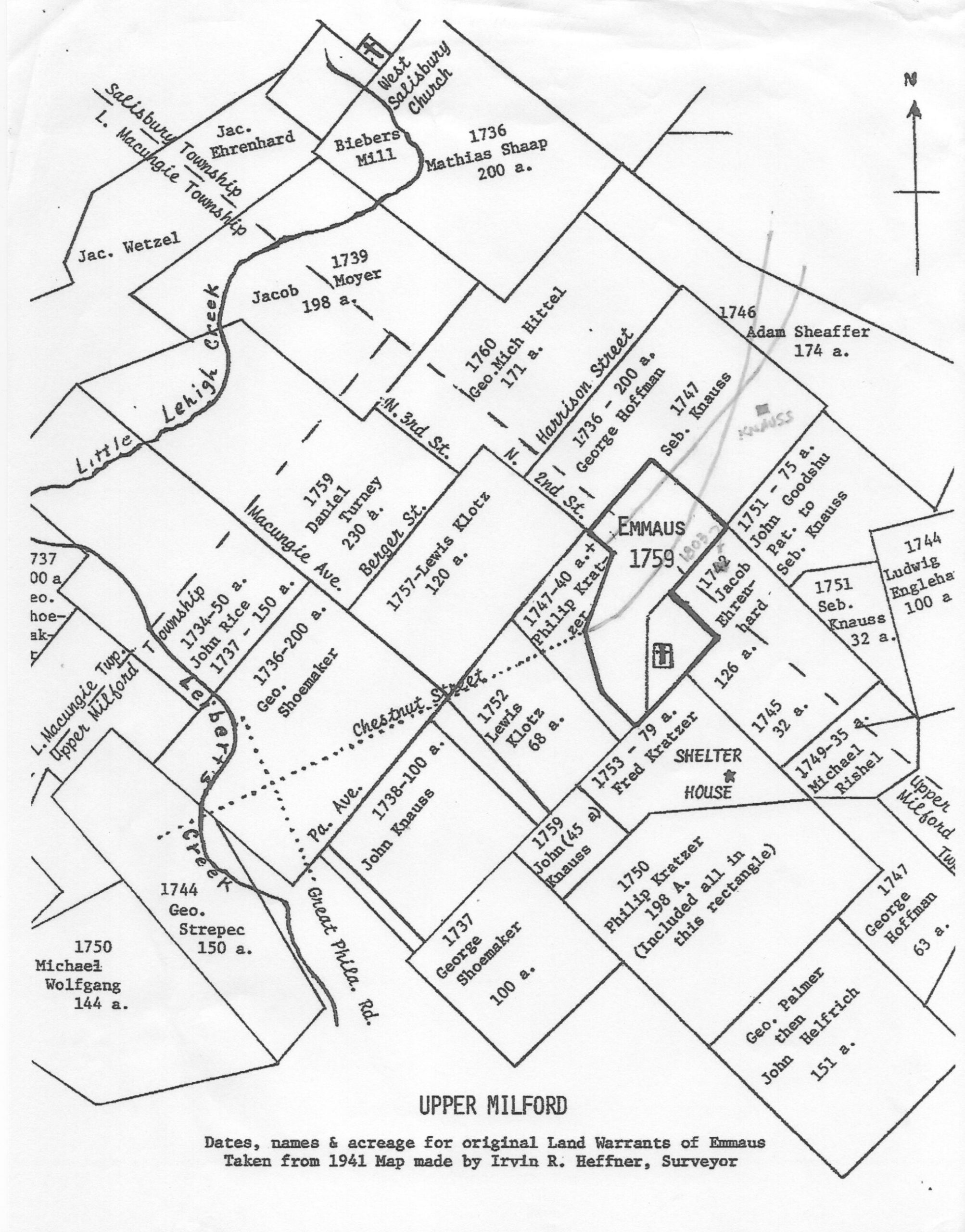
On July 30, 1747, the Moravians here formed a congregation of their own, with Sebastian Knauss and Jacob Ehrenhardt as its stewards. Over the next decade it grew into a plan for a village. The village was surveyed on December 23, 1758, and the next spring the two families gave the land: Sebastian deeded 45 acres and 25 perches to the Moravian Church on May 1, 1759, and Ehrenhardt gave about 55 acres three days later.
On April 3, 1761, Bishop August Gottlieb Spangenberg gave the village its name: Emmaus, after the village in the Gospel of Luke where two travelers met the risen Christ on the road.
Key dates
- 1723
Ludwig Knauss arrives
From Tittelsheim, in the Wetterau, with his wife Anna Margaretha. They settle at Whitemarsh.
- December 2, 1742
Zinzendorf preaches
In the house of Jacob Ehrenhardt.
- December 29, 1742
Received into the church
Sebastian Knauss, Jacob Ehrenhardt and others join the Bethlehem congregation. A log church is built the same year.
- July 30, 1747
A congregation of its own
Sebastian Knauss and Jacob Ehrenhardt are named stewards.
- December 23, 1758
The village is surveyed
- May 1 and May 4, 1759
The land is given
Sebastian Knauss, 45 acres and 25 perches; Jacob Ehrenhardt, about 55 acres.
- April 3, 1761
Named Emmaus
By Bishop Spangenberg.
The Knausses and the Ehrenhardts
In 1766 Sebastian’s eldest son, Heinrich, married Anna Marie Ehrenhardt. Eleven years later he built the house that stands here today.
James Owen Knauss and Tilghman John Knauss, History and Genealogy of the Knauss Family in America (Emaus: Knauss Family Association, 1915). Free to read at the Internet Archive. Sebastian Knauss’s deed of May 1, 1759 is recorded at Easton, Deed Book D, Volume 3, page 179. For the wider history of the town, see Preston A. Barba, They Came to Emmaus (1959).
Is one of these your ancestor?
Add your branch to the Descendant Registry for the 250th year.